IB Diploma Programme at AIS Singapore

Why Choose AIS for IB in Singapore?

The Australian International School (AIS) in Singapore offers the International Baccalaureate Diploma Programme (IBDP) as one of the pathways offered to secondary students in Years 11 and 12.

AIS also offers the Higher School Certificate (HSC) as an alternative senior secondary pathway for students planning to study in Australia.

The IBDP is a highly regarded qualification with global recognition, accepted by universities in over 140 countries. Students who successfully complete the IB Diploma at AIS open doors to top universities worldwide. As one of the leading IB schools in Singapore, AIS provides comprehensive support for students pursuing the IB Diploma Programme.

See how the IB Diploma Programme comes to life at AIS, book a campus tour to see the school in operation and meet our admissions team.

Not sure which pathway suits your child? Read our IB vs HSC comparison guide.
The IB Diploma: Education That Moves With Your Family

For internationally mobile families, the IB Diploma Programme offers continuity that national curricula cannot match. With over 6,000 IB World Schools across 160 countries, your child can continue the same rigorous programme whether your next posting takes you to Hong Kong, London, Dubai, or Sydney.

The IB curriculum is standardised globally, meaning students can transfer between IB schools without starting over or losing academic ground. This makes the IB Diploma an ideal choice for expat families who may relocate during the critical senior secondary years.

Schedule an online consultation, with our admissions team to discuss IBDP subject options and credit transfer.

AIS also offers the HSC pathway for families planning to return to Australia.

Our IB Results: 34.6 Average Score

  • Over 2000 graduates, our first student to receive a top IB Diploma score of 45/45 in 2017
  • 100 students yearly average cohort size
  • Graduates have found success in over 15 different countries
  • 34.6 IBDP Average Score versus world average 30.5 (last 3 years)
  • 8.5% received 40+ IB Diploma points in 2023
  • 22 IB Diploma Bilingual Diplomas in 2023

AIS students consistently outperform global averages. The global IB pass rate is 81% with an average score of 30.58, while AIS achieves a 95%+ pass rate with an average score of 34.6 points.

In Australia, IB students achieve a 92% pass rate compared to 72% globally, reflecting the high standards of IB education in the region.

The International Baccalaureate Diploma Programme

What is the International Baccalaureate Diploma (IBDP)?

The International Baccalaureate (IB) created the Diploma Programme (IBDP) in 1968. It is one of two IB programmes taught at AIS.

The other is the Primary Years Programme (PYP) taught in Elementary School. The language and philosophy of the IB Learner Profile underpins all IB curricula.

Designed as a pre-tertiary experience, the IBDP serves more than 1.95 million students worldwide and is recognised by leading universities across 140+ countries. The IB Diploma Programme develops critical thinking, research skills, and independent learning capabilities. 

How is the IBDP Curriculum Structured?

Students at AIS study six academic subjects over two years as part of the IB Diploma Programme. At least three subjects are studied at Higher Level (HL) and the remaining at Standard Level (SL). The IBDP requires mandatory studies in a native language, an acquired language, individuals and societies, experimental science, and Mathematics.

Additionally, IB Diploma students have 3 core components: Theory of Knowledge (TOK), Extended Essay (EE), Creativity, Activity and Service (CAS).

Creativity, Activity, Service (CAS)

CAS encourages IBDP students to remain physically active, to pursue a creative interest and to engage in service learning within the School and beyond. CAS helps teach students the importance of balance in their lives and provides an avenue to reflect on other ways of learning.

Theory of Knowledge (TOK)

TOK is an interdisciplinary critical thinking subject that encourages inquiry and intellectual curiosity within and between all IB Diploma subjects. This core component distinguishes the IBDP from other pre-university qualifications.

Extended Essay (EE)

The EE is a tertiary-level research paper of approximately 4000 words. IB Diploma Programme students are encouraged to use the EE as a tool to deepen their inquiry into a topic of special interest and work with a supervisor to help develop their line of investigation. Students can complete the EE in any one of their IBDP subjects. International-mindedness is explored through all parts of the IB Diploma.

What are IBDP Subjects?

The six subject groups for the IB Diploma Programme are:

Group 1 - Studies in Language and Literature

Language A – Literature:
English
OR
Self-Taught (SL only)

Language A – Language & Literature:
English
Mandarin Chinese

Group 2 - Language Acquisition

Mandarin Chinese B
English B
French B
Mandarin Chinese ab initio (SL only)
Spanish ab initio (SL only)

Group 3 - Individuals and Societies

Business Management
Economics
Geography
History
Psychology
Environmental Systems and Societies (SL only)

Group 4 - Experimental Sciences

Biology
Chemistry
Computer Science
Design Technology
Physics
Sports, Exercise and Health Science
Environmental Systems and Societies (SL only)

Group 5 - Mathematics

Mathematics: Analysis and Approaches HL
Mathematics: Analysis and Approaches SL
Mathematics: Applications and Interpretation HL
Mathematics: Applications and Interpretation SL

Group 6 - The Arts

Music
Theatre
Visual Arts

Which Universities Accept the IB Diploma?

Students with an International Baccalaureate Diploma have access to a wide range of universities worldwide. The IBDP is recognised and accepted by leading universities globally, offering students numerous options for higher education.

Research shows that IB students have higher university completion rates (research.acer.edu.au) than students from other curricula. Students should research the specific subject requirements for their desired career paths. For instance, if a student aspires to become a doctor, a strong foundation in science subjects such as Biology, Chemistry, and Physics is typically required.

IB schools in Singapore prepare students for entry to top universities in Australia, the UK, USA, and Asia-Pacific.

AIS IB graduates gain entry to world-leading universities, including:

  • Oxford and Cambridge (UK)
  • Stanford and Ivy League universities (USA)
  • University of Melbourne and Sydney (Australia)
  • NUS and NTU (Singapore)

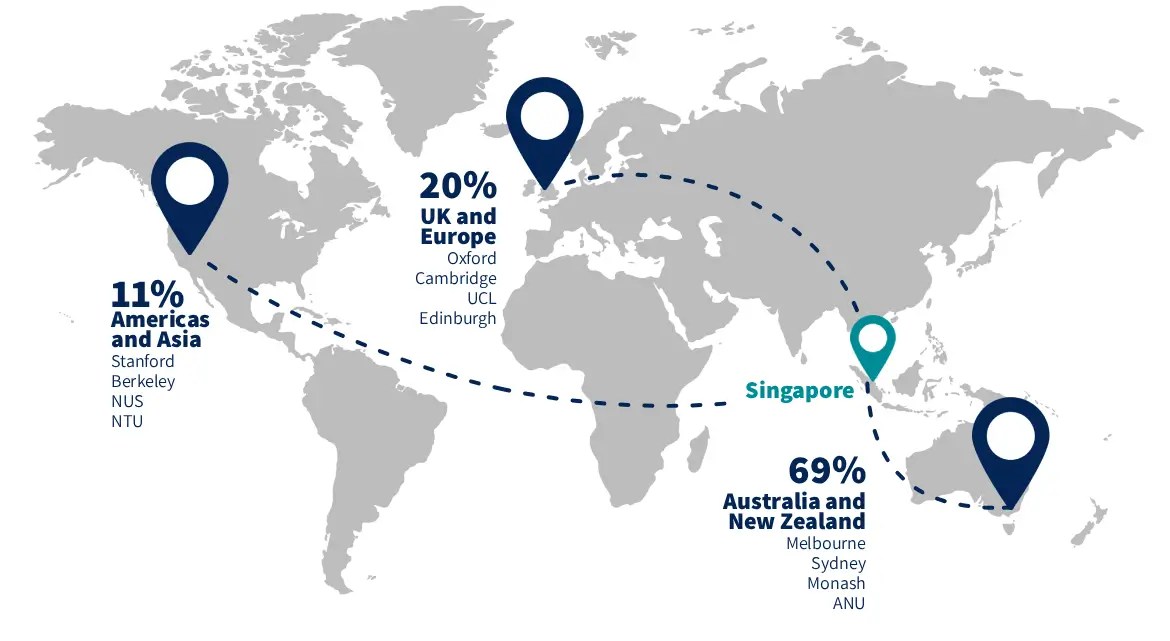
Where Our IB Diploma Graduates Study

Our graduates are accepted to universities across the globe:

University destinations-for AIS IB Diploma graduates

How is the IBDP Graded?

In the International Baccalaureate Diploma Programme, the total score ranges from 0 to 45. A student can achieve a maximum score of 45 points by earning the highest possible grade (7 points) in each of the six subject areas and accumulating additional points from the core components: Theory of Knowledge (TOK), Extended Essay (EE), and Creativity, Activity, Service (CAS).

To obtain the IB Diploma, students must meet certain requirements. They need to achieve a minimum total score of 24 points out of 45. This means that they must accumulate a minimum of 24 points across their six IBDP subject areas and fulfil the core requirements.

Take the next step in your child's education journey.

Personal school tours are perfect for families living in Singapore.

Schedule an online consultation if you are living overseas.

Experience Life at AIS Secondary

AIS Secondary Curriculum

Secondary School University Prep

Senior Curriculum Information Session

IB Diploma Frequently Asked Questions

Is the IB Diploma recognised worldwide?

The International Baccalaureate Diploma is recognised by universities in over 140 countries. IB schools in Singapore prepare students for entry to top universities in Australia, the UK, USA, and Asia-Pacific. The IBDP holds equal standing with A-Levels and other international qualifications. 

How does the IB Diploma Programme prepare students for university?

The IB Diploma Programme Singapore pathway builds critical thinking, research skills, and independent learning. IBDP students complete the Extended Essay, Theory of Knowledge, and Creativity, Activity, Service components. These elements develop the academic skills universities expect from IB Diploma graduates.

Are there extracurricular activities in the IBDP?

Yes. IB schools in Singapore integrate extracurricular activities with academic learning. Australian International School in Singapore offers 300+ co-curricular activities including sports, arts, clubs, and community service. These complement the IB Diploma Programme and support CAS requirements.

What support do IBDP students receive at AIS Singapore?

Australian International School Singapore provides experienced IB Diploma teachers, academic advisors, and dedicated resources. Students receive guidance for IBDP subject selection, university applications, and personal development. AIS Singapore maintains a 34.6 average IB Diploma score, above the world average of 30.5.

Can students transfer to the IB Diploma Programme from another curriculum?

Yes. IB schools in Singapore accept transfers from other curricula. The AIS Singapore admissions team assesses each student’s qualifications and supports the transition into the IBDP. Students from IGCSE, American, and other systems successfully enter the IB Diploma pathway.

What qualifications do IBDP teachers at AIS Singapore have?

IB Diploma Programme teachers at Australian International School Singapore hold bachelor’s or master’s degrees in their specialist subjects. All teachers complete IBDP-specific training and professional development. Faculty includes a Cambridge University music specialist, an IB Art curriculum developer, and teachers with industry expertise in their fields.

Why is AIS Singapore considered among the best IB schools in Singapore?

AIS Singapore achieves consistent IBDP results above world averages. Graduates gain acceptance to universities including Oxford, Cambridge, Melbourne, and NUS. The school offers three graduation pathways (IB Diploma, HSC, IB Courses+), giving students flexibility in their International Baccalaureate Diploma Programme studies. Small class sizes and personalised support contribute to student success.

What IB Diploma results does AIS Singapore achieve?

Australian International School in Singapore maintains a 34.6 average IBDP score across the last four years. The world average is 30.5. Students achieve 100% university acceptance rates. IB Diploma Programme graduates attend top universities across 15+ countries, with 69% studying in Australia and New Zealand, 20% in UK and Europe.

What is the difference between IB and A Levels?

The IB Diploma Programme requires six subjects plus core components (TOK, EE, CAS), giving students breadth across disciplines. A Levels allow students to focus on 3 to 4 subjects in greater depth. Neither is better or worse; they suit different learning styles. Both are recognised by universities worldwide.

For a detailed comparison, read our IB vs A Levels guide.

Can my child continue IB if we relocate?

Yes. The IB Diploma Programme is offered at over 6,000 schools across 160 countries. Because the curriculum and assessment standards are identical worldwide, students can transfer between IB schools without losing academic progress. This makes the IB an excellent choice for internationally mobile families.

AIS also offers the HSC pathway for families planning to return to Australia.

Learn More About the IB Diploma