Self-Regulation at AIS Singapore: A Guide for Parents
Every educator at Australian International School (AIS) Singapore is trained in Stuart Shanker’s approach to self-regulation. This guide explains what Self-Reg is, how we use it every day, and how you can support the same approach at home.
In our Early Years program, we believe that children learn best when they feel safe, calm, and connected. When those foundations are in place, children are ready to explore, take risks, build relationships, and grow. Everything we do in the Early Learning Village is designed to create those conditions, and self-regulation is at the heart of it.
What is Self-Reg?
Self-Reg® (the Shanker Self-Regulation method) is an approach to child development created by Dr. Stuart Shanker. It rests on one simple but powerful idea:
Children behave well when they feel well.
Behaviour is a child’s way of communicating. When a child’s needs for safety, connection, and good health are met, they are far better equipped to manage their impulses, cooperate with others, and engage with learning.
When children experience stress, it affects how they behave and learn. A child who is tired, hungry, overstimulated, or anxious cannot access their best self. They may have a meltdown, refuse to cooperate, or withdraw. Rather than reacting to the behaviour itself, Self-Reg asks our educators to look beneath it and consider: what is stressing this child right now?
Self-regulation is not about self-control or obedience. It is the ability to understand what you are feeling, recognise what you need, and manage stress in healthy ways. Young children cannot develop these skills alone. This is where the relationship between a child and a caring adult becomes so important.
What is co-regulation and why does it matter?
Co-regulation is the process by which a calm, caring adult helps a stressed child settle. Think of it as lending your calm to a child who has temporarily lost theirs.
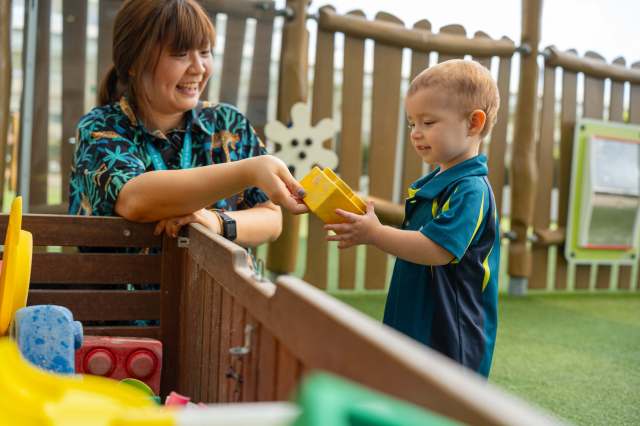
Our educators co-regulate with children every day, through their tone of voice, their body language, their calm presence, and the words they choose. These are not random responses. They are carefully considered, professionally developed skills that our team practises continually.
Over time, as children experience consistent co-regulation from trusted adults, they gradually build their own self-regulation skills. The early years are the critical window for this development. Research shows that early intervention produces the strongest and most lasting outcomes, which is why what happens in these first years matters so much. Consistency between school and home makes a real difference.
Understanding the five areas of stress
Self-Reg ® recognises that stress can come from five different areas of a child’s life. Understanding these helps parents and educators identify what might be behind a child’s behaviour and respond in a way that helps.
- Biological: Physical needs that are not met: not enough sleep, hunger, being too hot or cold, or needing movement.
- Emotional: Big feelings such as sadness, fear, frustration, or worry.
- Cognitive: Tasks that require significant thinking or concentration.
- Social: The effort of navigating relationships and interactions with others.
- Prosocial: The effort of sharing, taking turns, and being kind to others, which requires real self-management from young children, even when they genuinely want to do it.
How does Self-Reg ® benefit your child?
When children are consistently supported to recognise and manage their stress, the changes can be significant. This is supported by a growing body of research: a meta-analysis of 150 studies covering more than 215,000 children found that self-regulation in the early years is one of the strongest predictors of social, academic, and emotional outcomes across childhood and into adulthood (Robson et al., 2020).
- Greater emotional awareness: Children develop language to describe their feelings, which helps them understand themselves and communicate with others.
- Fewer meltdowns over time: When stress is identified and addressed early, children experience fewer big upsets.
- Healthier coping strategies: Children discover what helps them feel calm and regulated and carry those strategies forward.
- Stronger relationships: Children who feel understood and supported develop deeper trust with the adults around them.
- Greater readiness to learn: A child who feels settled is ready to explore, play, and engage with new ideas.
References
Pandey, A., et al. (2018). Effectiveness of universal self-regulation-based interventions in children and adolescents. JAMA Pediatrics.
Robson, D. A., Allen, M. S., & Howard, S. J. (2020). Self-regulation in childhood as a predictor of future outcomes: A meta-analytic review. Psychological Bulletin.
Valcan, D. S., Davis, H., & Pino-Pasternak, D. (2025). Parental discipline and self-regulation in children aged 2 to 5. Child and Youth Care Forum.
Shanker, S. (2016). Self-Reg: How to help your child (and you) break the stress cycle and successfully engage with life. Penguin Press.
Shanker, S. (2019). Self-Reg Schools: A handbook for educators. Pearson Canada.
If you would like to learn more about how AIS supports children’s development from 18 months to Year 13, or to book a tour of our Early Learning Village, please contact our Admissions team at admissions@ais.com.sg or visit ais.com.sg/admissions.
Frequently Asked Questions
What is the difference between self-regulation and self-control in children?
Self-control means forcing yourself to behave a certain way, often through willpower alone. Self-regulation means understanding what causes stress and learning to manage it in healthy ways. Self-Reg builds genuine wellbeing and the ability to make good choices, rather than simple compliance.
How do teachers help children calm down at school?
Co-regulation is how our educators support children when they are stressed. You might see a teacher notice that a child is becoming unsettled and offer a calm, supportive presence before things escalate.
If a child is struggling with a task, an educator might sit beside them and say: “This is tricky. I can see you are feeling frustrated. Let us breathe together and then decide: would you like a break, or shall we work on it together?”
When a child is upset, our educators get down to the child’s level, maintain a calm tone, and offer comfort through their steady presence. They might say: “I am here with you. You are safe.” The goal is always to help the child move from stress back to calm so they can think, learn, and connect with others.
How can I help my child manage their emotions at home?
When your child is struggling, pause and ask: what might be stressing them right now? Are they tired, hungry, or overwhelmed? Once you have a sense of the root cause, you can respond with empathy rather than frustration.
Try using calm words, offering comfort, and working through the difficulty together. Naming feelings helps: “I can see you are angry. That is okay. Let us find a way to feel better.” Modelling your own calm responses is powerful too. When children see adults managing stress, they gradually learn to do the same.
A useful question to keep in mind: Before responding to your child’s behaviour, ask yourself: “What might be stressing them right now?” That one shift in perspective can change the whole conversation.
What should I do when my child has a “meltdown” or emotional outburst?
Stay as calm as you can. Your calm presence is the most useful thing you can offer. Get down to your child’s eye level and let them know you are there: “I can see you are really upset. I am here with you.”
Do not try to reason or explain during the meltdown itself. When a child is overwhelmed, their brain is not in a state to process information. Offer comfort through your calm presence, a hug, a quiet space, or a familiar object. Once your child is calmer, you can gently talk about what happened.
Meltdowns are not misbehaviour. They are a sign that a child was overwhelmed and needed help. By staying calm and offering support, you are helping your child’s system settle, and that is exactly what our educators do at school too.
Will my child still learn right from wrong?
Yes. Children who develop self-regulation skills learn to manage themselves and make good choices, not because they have been told to, but because they understand why those choices matter. In fact, this tends to produce more genuine ethical reasoning than compliance alone. Children who understand the why are more likely to make good choices even when no one is watching. This kind of discipline grows with a child over time.
The evidence for this is strong: a systematic review published in JAMA Pediatrics (Pandey et al., 2018) found positive outcomes in every study that tracked conduct disorders and behavioural problems in children who received self-regulation support. A second meta-analysis of 150 studies covering more than 215,000 participants found self-regulation in preschool strongly associated with reduced aggression and better social outcomes (Psychological Bulletin, 2020).
How long does it take for self-regulation skills to develop in young children?
Every child develops at their own pace. Some children show changes within weeks; others need several months. What matters most is consistency. When children experience the same calm, supportive approach at school and at home, they begin to feel safer and more settled over time. Progress is not always linear. Be patient with yourself and your child and know that small steps forward are worth acknowledging.
Why does my child seem to be going backwards with their behaviour?
Regression is completely normal and does not mean something has gone wrong. Children often take a step back when they are stressed, unwell, or experiencing a change in routine. During these times, they need more support and co-regulation, not less. Once the underlying stress is addressed, children typically move forward again.
What happens if my child hurts or upsets other children at school?
We take safety very seriously and do not tolerate physical harm. If a child is hurting others, our educators intervene immediately to keep everyone safe. We support both children involved: the child who was hurt receives care and acknowledgement, and the child whose behaviour caused harm is supported to feel calmer and to understand the impact of what happened.
We use restorative approaches to help children learn from these moments. Rather than punishment, restoration focuses on understanding what happened, repairing the relationship, and building the skills to handle things differently next time. We always keep all families informed when safety incidents occur and work together on a shared plan that supports every child involved.

About the author
Stuart Armistead is Head of Early Years at Australian International School Singapore, with over 26 years of experience in international education.
Stuart previously served as Head of Primary (ages 3 to 11) at the International School of Lausanne, Switzerland, and has led several schools in New Zealand including a community of learning. He holds a Master of Education and Bachelor of Education from the University of Waikato, New Zealand. Stuart has served as Chairperson of the Swiss Group International Schools Primary Principal group, President of the Normal and Model School Association of New Zealand, and Advisor to the New Zealand Teaching Council. He is also an accreditation team member for the Council of International Schools (CIS) and the New England Association of Schools and Colleges (NEASC).
His leadership work spans dual language pathways, instructional coaching programs, innovation centre development, and teacher training across international school communities.