
What Are Your Options after ‘N’ Levels?
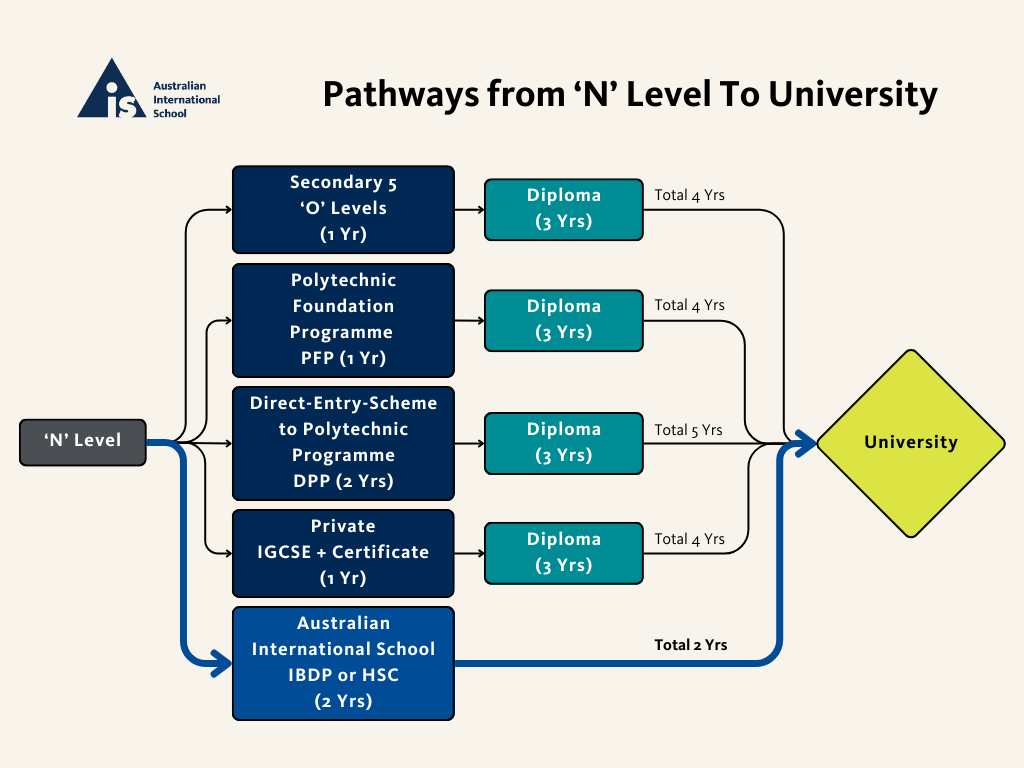
Congratulations on completing your N-level examinations! Now that you have your N-level results in hand, you’re standing at a crossroads with a multitude of educational pathways to choose from, each tailored to your unique preferences and goals. The question is what is the fastest pathway to get to the University of your choice? In this guide, we’ll walk you through the various options available for N-level graduates to enter Polytechnic institutions, private international schools and beyond.
Pathway 1: Continuing to Secondary 5 and O-Levels
If you’ve achieved exceptional scores in your N-levels and have a strong desire for academic excellence, one route you can take is to continue to Secondary 5. In this phase, you’ll prepare to sit for the GCE O-level examination, which is highly regarded both locally and internationally.
In order to advance to Secondary 5, it is essential to attain a qualifying aggregate score. It’s important to keep in mind that opting for this path will require a high level of concentration and self-discipline, as the transition from N(A) level to O level involves a significant leap in the syllabus.
What are the benefits of continuing to Secondary 5?
- Academic Rigour: The O-level curriculum is more challenging, providing students with a deeper understanding of their subjects.
- Broader Opportunities: O-levels open up a wider range of educational and career opportunities.
- Flexibility: It allows students to specialise in subjects of their choice.

Pathway 2: The Polytechnic Foundation Programme (PFP)
For those who prefer a more hands-on and practical approach to education, the Polytechnic Foundation Program (PFP) offers an excellent alternative. PFP is designed specifically for N-level graduates, providing a direct route into Polytechnic institutions.
In a nutshell, the Polytechnic Foundation Program (PFP) comprises two main elements: Core Subjects, which commonly encompass subjects like mathematics, science, and language arts, and Specialized Modules that students select based on their intended Polytechnic courses, including disciplines like Chemical Engineering, Apparel Design and Merchandising, Aviation Management, and Cybersecurity.
Upon successful completion of the PFP, students are eligible to enrol directly in their chosen Polytechnic courses. The foundation gained during the PFP helps them adapt more smoothly to the rigours of Polytechnic education.
This pathway entails one year of foundation coursework, followed by two years in Polytechnic. If your goal is to pursue university studies after graduation, it would entail an additional two years, resulting in a potential total of five to seven years of higher education.
What are the advantages of the Polytechnic Foundation Programme?
- Specialised Education: PFP focuses on specialised courses, preparing students for Polytechnic studies.
- Smooth Transition: It provides a seamless transition from N-levels to Polytechnic education.
- Skill Development: Students acquire practical skills that are highly valued in the job market.
Pathway 3: Direct-Entry-Scheme to Polytechnic Programme (DPP)
Another pathway to Polytechnic institutions is the Direct-Entry-Scheme to Polytechnic Program (DPP). This program allows N-level graduates to enrol directly in the Institute of Technical Education (ITE) for courses leading to a National ITE Certificate (NITEC) or Higher NITEC qualification.
What are the benefits of the Direct-Entry-Scheme to Polytechnic?
- Hands-On Learning: DPP emphasises hands-on training and practical skills development.
- Efficiency: It is a shorter route to Polytechnic, allowing students to enter the workforce sooner.
- Diverse Career Opportunities: DPP graduates can explore various career options.
Pathway 4: Private Education Institutions
Private education institutions, such as PSB and Kaplan, assist N-level graduates in their educational journey, particularly through the Cambridge International General Certificate of Secondary Education (IGCSE) Program. This program is a 5-month intensive course that prepares students for IGCSE examinations. After completing the IGCSE program, students can pursue certificate courses, which serve as stepping stones to diploma programs and degrees offered in partnership with renowned universities.
What are the advantages of private education after N-Levels?
- The high pass rate for IGCSE: Private institutions tend to boast high passing rates.
- Flexibility: Private institutions often offer flexible schedules and modes of study.
- Specialised Programs: Students can find niche programs tailored to their interests.
- Industry Connections: Some private institutions have strong industry ties, facilitating internships and job placements.

Pathway 5: International Schools and the IBDP or HSC
If you have aspirations of pursuing higher education on a global scale, enrolling in a private international school might be the right choice. Many international schools offer programs like the International Baccalaureate Diploma Program (IBDP) or the Higher School Certificate (HSC), providing a passport to universities worldwide.
Moreover, international schools provide a well-rounded education that goes beyond academics, encouraging students to explore co-curricular activities and develop holistically.
What are the benefits of the IB Diploma for N-Level students?
- Global Perspective: IBDP encourages a global outlook and critical thinking skills.
- Holistic Education: The IBDP curriculum emphasises critical thinking, research skills, and well-rounded development.
- University Readiness: IBDP prepares students for admission to universities worldwide.
- Language Proficiency: IBDP often involves bilingual education, enhancing language skills.

What are the benefits of the Higher School Certificate (HSC)?
- Broad Curriculum Choices: The HSC’s offerings enable students to explore their passions and interests, creating a well-rounded educational experience.
- Recognition and Acceptance: The HSC’s global recognition ensures that graduates have a passport to universities and educational institutions worldwide.
- Development of Critical Skills: Through the HSC, students develop crucial skills in critical thinking, research, and independent learning, preparing them for higher education and professional success.
- Pathway to Varied Careers: Holding an HSC provides students with diverse career opportunities, offering a solid foundation for pursuing their chosen professions and aspirations.
As you contemplate these options, remember that your choice should align with your passions, strengths, and future aspirations. Seek guidance from educators, admission managers and career counsellors to make an informed decision that sets you on the path to a successful educational journey and a promising future.

Consider the Australian International School Singapore (AIS)
The Australian International School Singapore (AIS) is a notable option for N-level graduates seeking a global educational experience. Located in Singapore, AIS offers a comprehensive and internationally recognised curriculum. At the age of 16, students can enrol in the International Baccalaureate Diploma Program (IBDP) or Higher School Certificate (HSC). Additionally, AIS offers valuable career guidance services to support students in making informed educational and professional decisions.
Choosing the Australian International School and the IBDP pathway can provide you with a world-class education and open doors to prestigious universities globally.
A notable advantage of enrolling in AIS is the seamless transition it offers to students completing their N Levels in October. They have the opportunity to join Year 10 in November, allowing them to become acquainted with the school’s teaching style for 2 months. This early start positions them to commence the new academic year in January, smoothly transitioning into Year 11 and the International Baccalaureate (IB) programme.
Frequently Asked Questions About N-Level Options
What are my options after N-Levels in Singapore?
After N-Levels, students have 5 main pathways: 1) Continue to Secondary 5 for O-Levels, 2) Polytechnic Foundation Programme (PFP), 3) Direct-Entry-Scheme to Polytechnic (DPP), 4) Private education institutions, or 5) International schools offering IB Diploma or Australian HSC. Each pathway suits different learning styles and career goals.
Can I go to polytechnic after N-Levels?
Yes, students with good N-Level results can enter polytechnic through the Polytechnic Foundation Programme (PFP) or Direct-Entry-Scheme to Polytechnic (DPP). PFP requires an N-Level aggregate of 12 points or better (ELMAB3), while DPP offers direct admission to specific polytechnic courses after completing a Higher Nitec at ITE.
Is IB Diploma better than O-Levels?
IB Diploma and O-Levels serve different purposes. O-Levels is a Singapore national qualification leading to JC or polytechnic. IB Diploma is an internationally recognised pre-university qualification accepted by universities worldwide. IB may suit students planning to study overseas or seeking a more holistic, inquiry-based curriculum with broader subject exposure.
Can N-Level students join international schools?
Yes, international schools in Singapore accept students from the local education system. Schools like Australian International School (AIS) offer the IB Diploma Programme or Australian HSC, providing alternative pathways to university without going through O-Levels or A-Levels. This can be a faster route for students who want to avoid the traditional Sec 5 → JC pathway.
What is the fastest pathway from N-Levels to university?
The fastest pathway is typically through an international school offering IB Diploma or HSC (2 years), compared to the traditional route of Sec 5 + JC (3-4 years) or Polytechnic (3 years + possible bridging). International school students completing N-Levels in October can join Year 10 immediately and start their IB/HSC in Year 11 the following January.
Contact Us
For further information, feel free to explore the various resources available to you. Your journey to higher education begins now, and the possibilities are boundless. If you wish to understand more about the pathways AIS offers please leave your details below and we will contact you.